Showing posts with label Mary. Show all posts

Sunday, December 7, 2025

Sermon: “The Art of ReGifting: REFLECT”, Luke 1:46-55 (December 7, 2025)

Last week we began our Advent series by considering why we need to fully receive and appreciate God’s gifts to us before we regift them to others. Without taking this first step in the process, we can’t explain why the gift is significant to us and why we want to pass it on. But as good as it feels to name the ways that God has blessed us, we can’t afford to get stuck on this step. Personal gratitude for God’s gifts is important, but it does very little to advance God’s kindom or make disciples on its own. So this week, we’re turning to Mary once again in order to learn what we should do next: the second step in regifting what God has given us. 

Wednesday, December 3, 2025

Liturgy: Advent 2: Reflect, Luke 1:46-55 (December 7, 2025)

    *You are welcome to use or adapt any of my resources for free, but I ask that you provide proper citation AND comment on this post to let me know that you have either used or adapted it.*


Hymns
Hymn GTG #100, “My Soul Cries Out” [vv. 1-3]
Hymn GTG #86, “The People Who Walked in Darkness” [vv. 1-3]


Sunday, November 30, 2025

Sermon: “The Art of ReGifting: RECEIVE”, Luke 1:26-38 (November 30, 2025)

In U.S.American culture, once we make it to the other side of Thanksgiving, our brains almost automatically shift towards preparing for Christmas, don’t they? In the Church, of course, we focus on preparing our hearts and spirits: getting ourselves in the right mindset to welcome Jesus to the world. At home, your preparation might look like decorating or baking; at work, it may take the form of frantic efforts to get things wrapped up before you leave for vacation. But no matter where you are or what you’re doing, I’d be willing to bet that your Christmas preparation involves gifts in one way or another.

Sunday, January 5, 2025

Sermon: “Into the Unknown", Luke 2:41-52 (January 5, 2025)


As many of you know, this past December was unusually rough for me, but for the first time in a long time, it doesn’t feel like the new month and new year offer a fresh start. If anything, I almost feel MORE dread for what comes next, and I know I’m not alone. I was joking with someone on Christmas Eve that, while I usually see social media flooded with posts full of hope that the new year will be better than the last, this year I saw a cartoon with a door labeled “2025” and people peering at it from around the corner, cautiously opening the door with a nine-foot broom. The characters in this cartoon are obviously not looking forward to finding out what’s behind that door, and that seems to be the vibe that we’re all entering this year with.

Tuesday, December 24, 2024

Sermon: “Mary’s Gift”, Christmas Eve Message (December 24, 2024)


During the past four weeks of Advent, we’ve been learning about the four women that Matthew includes in his version of Jesus’ genealogy: Tamar, Rahab, Ruth, and Bathsheba. Since the Christian tradition has historically privileged the actions and perspectives of men, it’s important for us to remember that Jesus’ life and ministry would not have been possible without these women. Not only literally, in that their bodies gave life to the ancestors that make up the line of David, but also through their gifts of tenacity, perception, companionship, and strength – a heritage that shaped God’s people and set the stage for everything that Jesus would be and do during his earthly life.

Sunday, December 18, 2022

Sermon: "When Words Aren't Enough: A Biblical Song of Joy", 1 Samuel 2:1-10/Luke 1:46-55 (December 18, 2022)


-------------------------------------------------------

When we think about “songs of joy”, we usually think of examples like “Ode to Joy” or “Joy to the World” – up-tempo tunes in major keys with lyrics of celebration and triumph, projecting euphoria with every note, reeking of sunshine and flowers and rainbows. That’s the baseline assumption about what a good song of joy should be – music that makes you happy. Sometimes, we seek this kind of song out when we’re feeling especially low as an emotional “pick-me-up”. In our quest for joy, we try to drive out our grief, lament, or anxiety by inundating it with as much audible happiness as we can stand.

Sunday, December 19, 2021

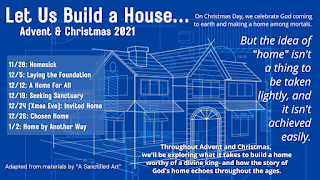
Sermon: “Let Us Build a House: Seeking Sanctuary”, Exodus 15:1-4, 10-13, 17-21/Luke 1:46-55 (December 19, 2021 -Advent 4)

(This is the fourth sermon in our Advent and Christmas series, "Let Us Build a House", based on the Advent theme from A Sanctified Art. The others can be found here and here - the third was given by a guest preacher.)


---------------------------------------------------------------

Throughout Advent, we’ve been examining the process of building a house to help us better understand how we should be working towards God’s kindom: the sense of homesickness that inspires us to start building, the importance of a strong foundation that allows us to build something taller and sturdier than we otherwise could, and the understanding that, at least as far as God is concerned, our house needs to have enough room to include everyone. But in all the dreaming and planning and striving we’ve been doing over the past few weeks, there’s one fact about building that we haven’t yet addressed. The truth is, no matter how hard we work to build it, it doesn’t matter how big or tall or wonderful a house is if it isn’t SAFE.

Sunday, April 12, 2020

Sermon: "Sensing the Sacred: Easter Sunday", Matthew 28:1-10 (April 12, 2020--Easter Sunday)

(This is the eighth and final sermon in our Lenten series, "Sensing the Sacred". 
The others can be found herehereherehereherehere, and here.
This message was a part of a larger worship service created by the Presbytery of Boise.)


--------------------------------------------------

This Lent, Boone Memorial Presbyterian Church has been exploring the ways we experience the sacred through our senses—smell, sight, taste, sound, touch, and thirst (since there are six weeks of Lent, I had to get creative and branch out from the traditional five senses). Since Christ was fully human and experienced life the way we do, there was plenty to explore in Scripture through our senses. We read about Nicodemus’ inability to see what Jesus was trying to show him, the thirst of the Samaritan woman, the touch that healed the blind man, the smell of a newly-resurrected Lazarus, the sound of the crowd on Palm Sunday, and the taste of the bread at the Last Supper. And on Good Friday, we immersed ourselves in the difficult sensory experience that is Jesus’ trial and crucifixion. 

Sunday, December 15, 2019

Sermon: “Imago Dei: In the Image of God’s Body”, Psalm 139:13-18/Luke 1:26-33, 38 (December 15, 2019)

(Week 3 in our Advent series on how we reflect God's Image--
previous weeks' sermons can be found here and here)


*To expand upon the disclaimer in the sound file: this was a particularly challenging sermon to write because everyone has a different relationship with their body, and I know that talking about bodies can be painful for different people in a million different reasons. In addition to the footnote I added below, I want to reaffirm here: your body is holy, not because of what it looks like or how it works, but because of what you use it for. And as long as you're using it to love others and share God with the world, you're doing it right.

If you're still in the middle of coming to terms with what your body is or isn't, what it can or cannot do, know that God is with you in that journey, and that no matter where you end up and what you discover, God will still love, cherish, and value you just as much as when God knit you together in your mother's womb.  --KSW 

---------------------------------------------------------------

Human bodies have long been a point of contention in Christian communities. Although we worship an incarnate God, our own bodies have at times become targets of disdain and disgust. Historically, certain groups have seen the body as inferior to the spirit because of its finite and corruptible nature. They see physicality as something impure to be endured and transcended if at all possible. Individually, many of us see our own bodies as an inconvenience or a burden. For some of us, chronic illness or even just normal aging can make us question if having a body is worth the pain that we suffer because of it. Whether for functional or aesthetic reasons, most of us have been unhappy with our bodies at one time or another.