Showing posts with label kingdom. Show all posts
Showing posts with label kingdom. Show all posts
Sunday, October 29, 2023
Sermon: "From Scratch", 1 Kings 12:1-17 (October 29, 2023)
Wednesday, October 25, 2023
Liturgy: The Kingdom Divided, 1 Kings 12:1-17 (October 29, 2023)
*You are welcome to use or adapt any of my resources for free, but I ask that you provide proper citation AND comment on this post to let me know.*
Hymns:
GTG #275, “A Mighty Fortress Is Our God”
GTG #379, “We Shall Overcome”
GTG #313, “Lord, Make Us More Holy”
Sunday, January 22, 2023
Sermon: "May Your Life Be a Blessing", Matthew 5:1-20
Ah, the Beatitudes. Although Matthew’s gospel technically begins Jesus’ ministry at very end of chapter 4, the Sermon on the Mount is the first of Jesus’ teachings that Matthew reports in full, and the Beatitudes are the very first words of it that he speaks. We’re all familiar with the formula, although we may recall different words: “Blessed are the poor in spirit; blessed are the meek, blessed are the merciful.”
Sunday, August 7, 2022
Sermon: “God’s Embassy on Earth”, Psalm 33:12-22/Hebrews 11:1-10, 13-16 (August 7, 2022)
Over the past several years, Christian nationalism has been on the rise. And we here in the United States aren’t the only participants in this trend: the Wikipedia page for “Christian nationalism” lists Canada, Russia, the United States, and Yugoslavia as modern examples of countries that have, to one degree or another, embraced this ideology. In some cases, Christian nationalism emerges out of the best of intentions – a belief that Christian policies and laws would improve life for everyone. In others, it’s a tactical strategy – if an individual controls both the state AND the Church, then there’s very little that can stand in the way of their political aspirations. Regardless of where on this spectrum a person’s motivations lie, the objective of Christian nationalism remains the same: a blurring, if not outright removal, of the line between Church and state.
Sunday, May 22, 2022
Sermon: “The Literal Kindom – Metaphorically Speaking”, Acts 16:9-10, 13-15/Revelation 21:10, 22--22:5 (May 22, 2022)
Visions are relatively common in scripture. Usually, they’re described as if the person experiencing them were watching a movie play out in their mind. As a result, we tend to equate divine visions with literal instructions from God. It seems unfair that people like Paul and John of Patmos receive such clear direction, while we’re stuck praying and discerning. But biblical visions aren’t necessarily what they seem – and they aren’t necessarily just for those who receive them.
Sunday, May 15, 2022
Sermon: "Big Burger Thinking", Acts 11:1-18 (May 15, 2022)
Did you know that in this country, the standard size of a commercial cheeseburger is the result of our collective inability to understand a basic mathematical concept?
It’s true. A decade after McDonald’s first introduced the Quarter Pounder, A&W decided to introduce the “Third-of-a-Pound Burger”. They figured by offering more meat at the same price, they could successfully take on the golden arches. Their version even performed better in taste tests. But the Third-of-a-Pound Burger failed commercially for a simple and absolutely ridiculous reason: it turns out that the general public doesn’t understand how fractions work. Even though the A&W burger was technically a better deal, people thought that they were being asked to pay more for less burger. They thought that 1/3 was smaller than 1/4.[1]
Let that sink in for a minute. As a society, we’re stuck with smaller burgers because of our own mathematical ignorance.
Sunday, November 7, 2021
Sermon: “Momentary Saints”, 1 Samuel 3:1-10/Revelation 21:1-6 (November 7, 2021)
In Christian circles, we talk about “God’s kindom” or “the kindom of heaven” all the time, but we tend to have a limited understanding of what it is, precisely, that we’re talking about. We know it’s really, really good, that it’s “already and not yet” here (whatever that means), and that it will mark Christ’s return. Other than that, we’re pretty clueless.
That’s where apocalyptic literature like Revelation comes in handy. Hopefully, you remember that, theologically speaking, an apocalypse isn’t actually defined as a catastrophic event. Our English word is derived from a Greek verb meaning “to uncover or reveal”. And in the context of scripture, apocalyptic literature refers to writings that uncover or reveal God’s kindom to us.
Sunday, July 18, 2021
Sermon: "Imagine the Kindom", Jeremiah 23:1-6/Mark 6:30-44 (July 18, 2021)
*NOTE: I use the word "kindom" instead of "kingdom" in order to emphasize the dynamic relational aspect of the world that we create with God more than the dominant/submissive relationship that "king"dom implies. The two words refer to the same idea.*
I have to admit that if you asked me my favorite story, it probably wouldn’t be one from the Bible. If I had to pick, I’d probably say Peter Pan. There’s just something so relatable and poignant about the stubborn desire to stay young and carefree forever. I’ve read the original novel, seen the musical adaptation (of course) and many versions of the movie; every single interpretation does a beautiful job playing with the tension between the gifts of childhood and the expectations of adulthood.
Arguably, few movies do this more creatively than Steven Spielberg’s 1991 film, “Hook”. This movie asks the question, “What would happen if Peter Pan actually DID grow up?” The answer, apparently, is “become a corporate lawyer.” Peter has grown up and completely forgotten about his former life. When his two children are kidnapped by Captain Hook, Wendy (whose family he married into) breaks her silence and reveals to Peter that he is, in fact, Peter Pan, and must go to Neverland to rescue the children. Peter, being a very reasonable sort of man, is unconvinced, but Tinkerbell drags him away to Neverland anyway.
Sunday, June 13, 2021
Sermon: “God’s Co-Op”, Genesis 2:4-9a, 15, 18-22/Mark 4:26-32 (June 13, 2021)
God’s kingdom has been compared to a lot of things. According to Jesus, the Kingdom of God is like a treasure hidden in a field, a pearl of great price, yeast, a fishing net, a landowner hiring day laborers, a wedding banquet, servants entrusted with talents, and so on and so on. All revealing something important about God’s kingdom, and yet all (to our modern ears, anyway) rather enigmatic. (What actually *is* a talent, anyway?) If even the disciples struggled to extract meaning from these parables in their context, what hope do we have today?
Sunday, March 14, 2021
Sermon: “Recipe for Repentance: Reorientation”, John 3:14-21 (March 14, 2021)
(This is the fourth sermon in our Lenten series, "Recipe for Repentance". Previous sermons can be found here, here, and here, and the Ash Wednesday message can be found here.)
I remember the first time I saw someone holding a “John 3:16” sign at a sporting event. I was probably in middle school or thereabouts. I asked my parents why, out of all the verses in the Bible, someone would choose to hold up that one, and they said something like, “Because that verse is a summary of the whole gospel message.” After I looked it up (I wasn’t yet the biblical prodigy you see standing before you today), I was puzzled. I mean, yes, John 3:16 by itself is technically a spoiler for the rest of the story, but as far as I could tell with my limited preteen theological prowess, it wasn’t really communicating anything new, insightful, or uniquely compelling. Why, I wondered, would someone attempting to evangelize to a (presumably) non-Christian audience choose THIS verse to represent the Good News?
Sunday, May 31, 2020
Sermon: "Pentecostal Power", Acts 2:1-21/Numbers 11:24-30 (May 31, 2020--Pentecost)
------------------------------------------------------
Today is Pentecost. We’re all familiar with the account from Acts 2 that I read “In Other Words” a few minutes ago, where the Holy Spirit descends on the gathered community like “divided tongues of fire”. It’s a beloved story that we fondly call “the birthday of the Church” because it’s the point at which the disciples pivot from feeling lost without Jesus to taking ownership of their own ministry. It’s the point at which the gift of the Holy Spirit gives the community a sense of unity and agency.
Sunday, November 17, 2019
Sermon: "A Strange Sort of Hope", Isaiah 65:17-25/Luke 21:5-19 (November 17, 2019)
We’re coming up on a new year in just about a week. No, I didn’t misplace my calendar or accidentally recycle an old sermon at the wrong time. Our liturgical year is coming to an end next week with Christ the King Sunday. And just as with our secular celebration of the new year, it’s a good opportunity for us to look towards the future and imagine what it has in store for us. In the Church, this means engaging in a bit of friendly eschatology—or, in laymen’s terms, thinking about Christ’s return, when the present world will come to an end.
Sunday, October 20, 2019
Sermon: "Of Saints and Seedlings", Jeremiah 31:27-34/2 Timothy 3:14-4:5 (October 20, 2019)
Okay; don’t tell anyone, but I have a problem with scripture.
Well, that’s not entirely accurate. What I actually have a problem with is a particular scripture-related metaphor. In Luke 8, Jesus tells the parable of the sower (which our kids presented beautifully a couple of weeks ago) and then, in a rare move, he explains what the parable means so that there can be no confusion: the seeds that the farmer sows represent the Word of God, and the different types of soil that they land in represent our potential attitudes when we hear the Gospel. In other words, how we receive the Good News determines whether or not it’s able to take root in our hearts.
Monday, July 8, 2019
Sermon: “Unearned, Unasked-for, Undeserved”, 2 Kings 5:1-14/Luke 10:1-11, 16-20 (July 7, 2019)

--------------------------------------------------
Let’s talk about privilege.
For some, it’s a dirty word. It immediately puts us on the defensive, and we feel like our struggles and challenges are being ignored. We feel like it minimizes the hard work that we put in to get where we are. We feel like we’re being told that we’re a bad person. But interestingly, there’s another word that means almost exactly the same thing which for some reason doesn’t have the same distressing connotation to us, one that we Christians are often comfortable with and even eager to apply to ourselves
Sunday, April 21, 2019
Sermon: "Rock of Ages: Resurrection", Isaiah 65:17-19, 23-25/Luke 24:1-12 (April 21, 2019--Easter Sunday)
(This sermon is the last in our Lenten Series, "Rock of Ages", in which we're exploring how rocks can symbolize different characteristics of God and of ourselves.)
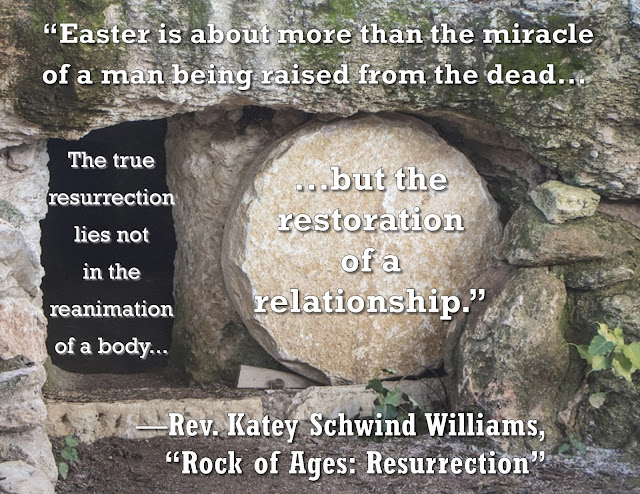
Over the past six weeks of Lent, we’ve explored all the different things that stones can teach us about our faith. We talked about the pitfalls of wanting to be in control and how fighting God’s sovereignty is like a softer stone trying to scratch a diamond. We discussed how God’s faithfulness doesn’t lift us up and away from our problems but keeps us going in the midst of them, like standing on a submerged rock to keep from drowning. We considered the stones NOT thrown—how we can build the kingdom of God here on earth if we choose to lay down our weapons and use them as building blocks, instead. We gave thanks that commitment to God can make us feel like we’ve come home, and we realized how important it is to surround ourselves with reminders of that commitment, whether in the form of massive stone monuments or in a holy meal or sacred font. On Palm Sunday, we were challenged by Jesus, as we considered whether WE might be the “stones” that he calls upon to shout out in witness to God. And on Maundy Thursday, we remembered that our brokenness doesn’t keep God from using us to build God’s kingdom—we can still be the rock upon which the Church is built, even when we feel deeply flawed and unworthy.
And finally, today we arrive at Jesus’ tomb with the women and see the stone rolled away. Today, the stone reminds us not of our struggles or our brokenness, but of resurrection. Thanks be to God!

--------------------------------------------------
Over the past six weeks of Lent, we’ve explored all the different things that stones can teach us about our faith. We talked about the pitfalls of wanting to be in control and how fighting God’s sovereignty is like a softer stone trying to scratch a diamond. We discussed how God’s faithfulness doesn’t lift us up and away from our problems but keeps us going in the midst of them, like standing on a submerged rock to keep from drowning. We considered the stones NOT thrown—how we can build the kingdom of God here on earth if we choose to lay down our weapons and use them as building blocks, instead. We gave thanks that commitment to God can make us feel like we’ve come home, and we realized how important it is to surround ourselves with reminders of that commitment, whether in the form of massive stone monuments or in a holy meal or sacred font. On Palm Sunday, we were challenged by Jesus, as we considered whether WE might be the “stones” that he calls upon to shout out in witness to God. And on Maundy Thursday, we remembered that our brokenness doesn’t keep God from using us to build God’s kingdom—we can still be the rock upon which the Church is built, even when we feel deeply flawed and unworthy.
Subscribe to:
Posts (Atom)